MBBS, DGO, DNB (OBG), Fellowship in Reproductive Medicine
Consultant - IVF Specialist, Female Sexual Health & Gynaecology

MBBS, MS (Surg), DNB (Uro), ChM (Edinburgh), FECSM, Fellow Andrology (Spain)
Sr. Consultant Andrologist & Urologist
Intrauterine Insemination (abbreviated as IUI) is a type of fertility treatment in which a specially prepared sperm sample is directly placed into the woman’s uterus during her ovulation. This allows healthy, washed, and concentrated sperm to be closer to the egg, thus increasing the chances for natural fertilisation. This is one of the simplest and minimally invasive assisted reproductive treatments, and healthcare providers may recommend IUI before in vitro fertilisation (IVF). For couples looking for IUI treatment in Bangalore, IUI is a logical starting point, as it is simpler, minimally invasive, and less expensive than IVF.
Whether or not IUI is the right choice for you depends on your individual situation. However, the procedure generally tends to help couples struggling with mild male infertility, ovulation disorders, unexplained infertility, cervical factor infertility, sexual dysfunction, or when donor sperm is used. It is important to note that unlike an IVF procedure, fertilisation in IUI does not take place outside the woman’s body. The fertility treatment simply makes it easier for natural fertilisation to occur by boosting the chances through artificial insemination.
Since IUI outcomes depend on careful patient selection and precise timing around ovulation, the process works better when careful evaluation of both partners is done beforehand. The treatment will then be personalised for the couple based on factors like age, ovarian reserve, duration and cause of infertility, sperm quality, and previous fertility treatments, if any.
At NU Hospitals, Bangalore, fertility treatments are never made following a “one-size-fits-all” rule. Instead, our experienced healthcare providers take the couple’s individual needs into account before curating a plan that will work best for them. It is because of this personalised approach, along with state-of-the-art diagnosis, ovulation monitoring, and a team of specialist professionals you can depend on, that NU Fertility is so trustworthy.
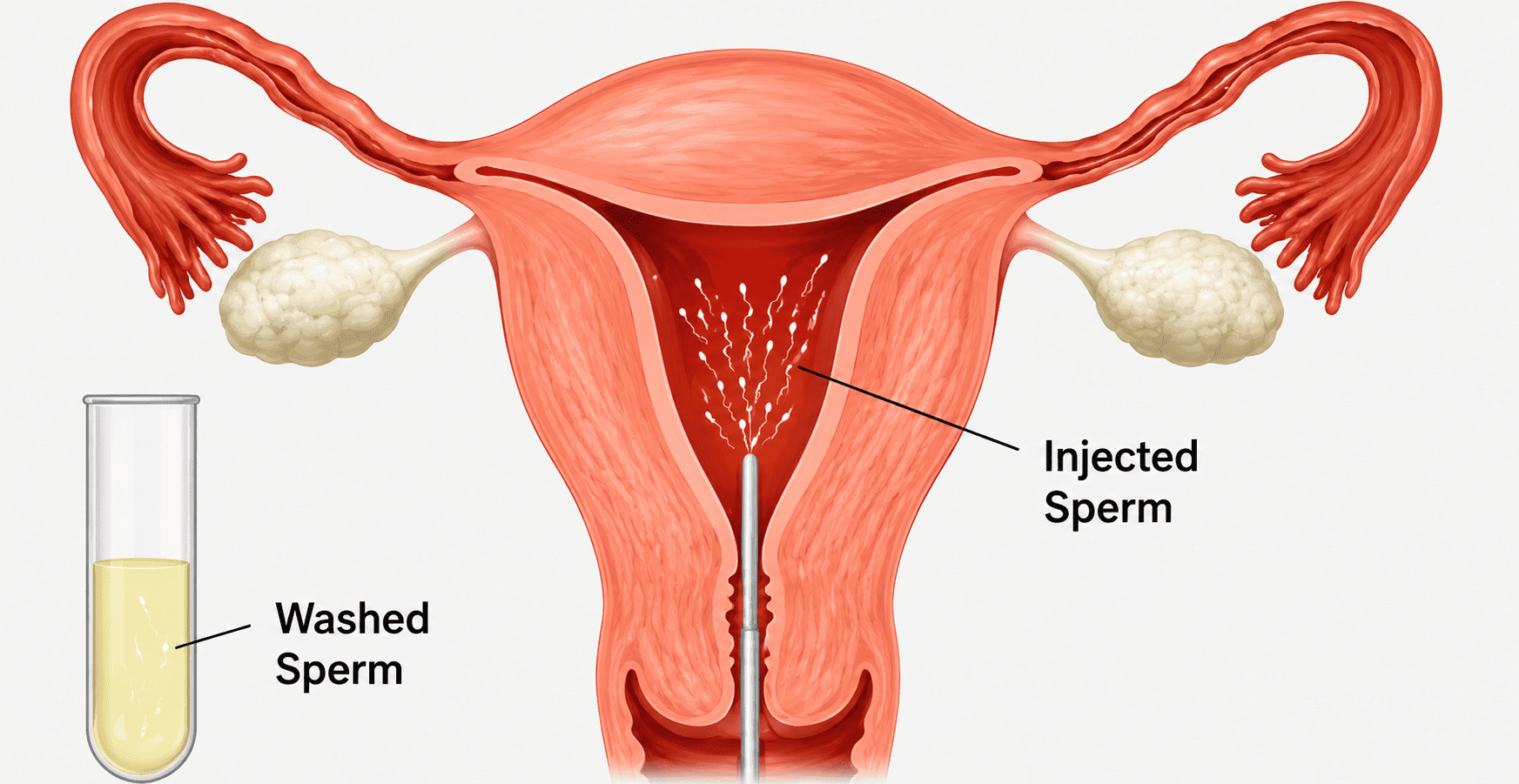
Assisted Reproductive Technology (ART) has helped many people and couples fulfil their dream of having a child. One such method is intrauterine insemination. Here, washed and concentrated sperm is placed directly into the woman’s womb using a thin tube known as a catheter. This makes it much easier for sperm to meet the egg, as it reduces the distance sperm cells have to travel. IUI works wonders when your sperm has low motility or cannot survive for long in the female reproductive tract.
By washing the sperm, healthcare providers are essentially getting rid of seminal fluid, debris, and low-motility sperm, thus creating a concentration of healthy and motile sperm. As mentioned before, IUI only makes fertilisation easier; the real process naturally happens inside the woman’s fallopian tubes. This also makes the process less invasive compared to IVF.
Based on the patient’s situation, IUI may be performed during a natural menstrual cycle or after ovulation induction through medication. Remember, not every person facing infertility would be a suitable candidate for IUI, as it depends entirely on what the evaluation reveals.
Like any other treatment, IUI will work best when it is provided to the right patient at the right time. This is why a complete fertility evaluation of both partners is equally important. Those who can benefit from IUI treatment include:
Women who face irregular or infrequent ovulation can benefit from IUI, especially when the procedure is done after ovulation induction. This includes:
After a semen analysis, results might show mild abnormalities. In such cases, artificial insemination can help the couple by concentrating the healthy sperm and putting them closer to the egg to support fertilisation. Suitable cases include:
The cause of infertility is sometimes unknown. Your doctors may run multiple tests and still fail to find anything that would explain why you have not been able to conceive naturally. In these situations, IUI treatment and ovulation induction may be an option. If IUI doesn’t work, your healthcare provider may discuss moving on to IVF.
The cervix and cervical mucus are key in terms of directing sperm toward the egg. If something interferes with this natural pathway, an IUI procedure can help. This applies to conditions like:
In some cases, the sperm may be healthy, but couples may still face physical or functional barriers to conception. IUI can then help those dealing with:
Sometimes, male factor infertility may be extreme, which reduces the chances of natural fertilisation significantly. In other cases, there may be a risk that the baby will inherit certain genetic conditions. Here, donor sperm can be used through IUI.
While intrauterine insemination is a great option for couples looking to start their fertility journey, it may not be for everyone. IUI is generally advised against when the underlying cause of infertility cannot be bypassed through the procedure. This includes:
In these cases, IVF or other ART techniques like ICSI may prove to be more effective. It is best to have a detailed discussion with a fertility specialist about the various options of fertility treatment in Bangalore at the earliest.
Once intrauterine insemination is brought into the conversation, your doctor will put you through a detailed fertility evaluation to make sure whether IUI is the best option for you or not. This assessment will not only help you understand where you stand but also inform treatment planning.
The female partner will generally have to go through the following tests and assessments:
For the male partner, the tests will consist of:
Once the test results are in and a green light is given to continue with the IUI procedure, fertility specialists at NU Fertility will create a personalised treatment plan for you based on individual factors like your age, the status of your ovarian reserve, the cause and duration of infertility, sperm quality, and your history of fertility treatments. Remember, no two treatment plans will look the same, as each fertility journey is different.
To make sure artificial insemination is done close to ovulation, the procedure has to be carried out in carefully timed stages. This will increase the chances of fertilisation and conception.
The timing of ovulation matters greatly when planning an IUI treatment. This allows the doctor to identify a woman’s most fertile period, increasing the chances of fertilisation. This stage can include:
Once a follicle has reached the appropriate size, fertility specialists may use an hCG trigger injection. This will help them accurately time ovulation before beginning artificial insemination.
On the day of the procedure, the male partner’s semen sample is collected and taken into the laboratory for preparation. In some cases, including those using a sperm donor, the semen sample can be taken beforehand and frozen. On the day of the procedure, the sample will be thawed before preparation. During preparation, the sample undergoes sperm washing, which accumulates a concentration of healthy sperm, which is to be inserted into the uterus.
This step basically consists of:
This is the part where artificial insemination takes place. The woman should be lying down on the exam table. The doctor will then insert a speculum into her vagina, which allows them to insert a catheter into the uterus through the cervix. The washed and concentrated healthy sperm is then injected into the womb. This process takes only a few minutes and is rather simple.
After the IUI procedure, the woman may be asked to remain lying down for about ten to thirty minutes. She may also be given progesterone, which maintains the uterine lining and supports early pregnancy. Afterwards, the woman can resume her daily activities without issue. Fertilisation will happen if the sperm successfully combines with the egg. You can take a pregnancy test after a two-week wait. A follow-up consultation will be provided for further planning.
Intrauterine insemination is the first step in fertility planning for many couples, and for all the right reasons. Benefits of IUI include:
We know that intrauterine insemination is a rather safe procedure. However, there are certain risks and limitations that one should be aware of when planning to go for an IUI procedure.
Women can experience light spotting or mild cramping soon after the IUI treatment. Both of these side effects usually resolve quickly on their own. Infection can also occur, but the chances are low. When medication is used to stimulate ovulation, there is an increased chance of multiple pregnancies, as more than one egg can be released and fertilised. Ovarian hyperstimulation syndrome is also a rare but possible risk.
Along with risks, there are also certain limitations of artificial insemination, including the fact that it can have low success rates in cases of severe infertility. The IUI success largely depends on the underlying condition(s) of infertility, and patients may need to undergo multiple cycles of treatment. In the end, other ART methods such as IVF may be the preferable choice in such scenarios.
There are multiple factors that will decide how successful IUI treatment is going to be for a particular couple. These include the woman’s age, egg quality and ovarian reserve, and whether the fallopian tubes are open and working normally. Also important are the precise timings of ovulation, the thickness and receptivity of the endometrial lining, and the quality of the sperm sample. The length of time a couple has been trying to conceive, the particular underlying fertility diagnosis, and general lifestyle factors such as smoking, weight and general health can all impact outcomes too.
Treatment planning at NU Fertility is always individualised and never a one-size-fits-all protocol, for exactly these reasons.
Choosing the right fertility partner matters as much as choosing the right treatment. NU Fertility for IUI treatment in Bangalore provides its patients with:
We at NU Hospitals realise that the same treatment course cannot be applied to every patient who walks in. This is why we believe in personalised, evidence-based fertility care, delivered with genuine compassion.
If you wish to include NU Hospitals in your fertility journey, you can book an appointment with us on our website or visit us in person.
Our team of IVF specialists in Bangalore have been known for their extensive clinical experience and research contributions and their success in treating the most challenging fertility cases.
MBBS, DGO, DNB (OBG), Fellowship in Reproductive Medicine
Consultant - IVF Specialist, Female Sexual Health & Gynaecology
MBBS, MS (Surg), DNB (Uro), ChM (Edinburgh), FECSM, Fellow Andrology (Spain)
Sr. Consultant Andrologist & Urologist
I would suggest this hospital for everyone especially who is struggling long time for baby. This hospital works so systematically that you don’t have to wait longer time to meet doctors. I must thank Rajitha who used to track immediately my files and send me to concerned person or place. Dr.Sneha has enlightened my life. She guided me in each step. Continuous monitoring of patient and guiding on each phase is very important which is totally taken care here by doctor. Unlike other hospitals , they don’t waste time and money. Please consult Dr.Sneha if you are planning for IUI or IVF. She is very kind and humble. My hearty thanks to Dr.Sneha.
S Revathi
Dr Sneha hands down is one of the best infertility specialist in town. With immense knowledge and the best credentials (of AIIMS and milan) yet she’s so humble and patient. I went through an ivf and she made it possible in the first shot. Happy to have twins🤗
She is always available to answer all doubts. After 3 years of disappointment from multiple doctors in Bangalore she undoubtedly has been the best and got me lucky. Thank you Dr Sneha for your time, patience and most importantly empathy and my twins🙏🏻🙏🏻
Chabi Anand
I met Dr Pramod Krishnappa. All my problems were cleared without any doubt. Service is good
Shiva
The NU Fertility and the work of Pramod sir require a lot of appreciation and due respect. The entire team and hospital staff are very kind and helpful nature including the outsourcing canteen staff and counter people. This hospital deserves international access God bless ? your team sir may you have all of god’s gifts and success.
Venugopal M
The consultation with Dr. Pramod was good and the staff helped a lot with the process too. Thank you for the treatment.
Chitra A L
Got my surgery done here. Special shout-out to Doctor Pramod, Doctor Gautam, and Doctor Ambika for their support. Wards are well maintained, and the nursing staff periodically keeps monitoring you very diligently. Mr Santosh ensured the smooth processing of insurance. Also, the canteen staff ensured the timely delivery of healthy, nutritious food. Overall, a positive experience.
Arvind Manavasi
In an IUI treatment, fertility specialists directly place washed and healthy sperm into the woman’s uterus by using a catheter. This aids natural fertilisation.
No. Most women experience little or no discomfort from IUI. It takes only a few minutes to perform and requires no anaesthesia.
In IVF, fertilisation happens artificially in a lab after both eggs and sperm are retrieved from the patients. In IUI, only sperm is retrieved and placed into the uterus.
The IUI procedure itself takes only a few minutes to complete, but doctors will probably have you resting for up to 30 minutes after.
It is recommended to take a pregnancy test two weeks after the IUI procedure. You can follow up with your fertility specialist afterwards.
NU Fertility © 2026. All Rights Reserved. Terms of Use and Privacy Policy
 Female Infertility
  Ovulation Induction
  IUI
IUI  IVF/ICSI
  Frozen Embryo Transfer (FET)
  ERA Test
  IVM Fertility Preservation
  Laparoscopy and Hysteroscopy
  Men's Sexual Health
  Male Fertility Conditions